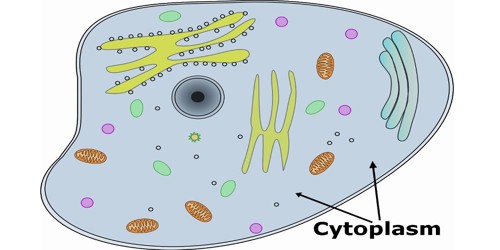
cytoplasm, the semifluid substance of a cell that is external to the nuclear membrane and internal to the cellular membrane, sometimes described as the nonnuclear content of protoplasm. In eukaryotes (i.e., cells having a nucleus), the cytoplasm contains all of the organelles. Among such organelles are the mitochondria, which are the sites of energy production through ATP (adenosine triphosphate) synthesis; the endoplasmic reticulum, the site of lipid and protein synthesis; the Golgi apparatus, the site where proteins are modified, packaged, and sorted in preparation for transport to their cellular destinations;.
Cytoplasm is a thick solution that fills each cell and is enclosed by the cell membrane. It is mainly composed of water, salts, and proteins. In eukaryotic cells, the cytoplasm includes all of the material inside the cell and outside of the nucleus.
 \
\
