FACTORIZATION
FACTOR
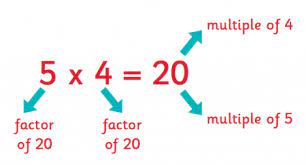
A number which divides the other number exactly is called a factor of that number.
PRIME AND COMPOSITE NUMBERS:
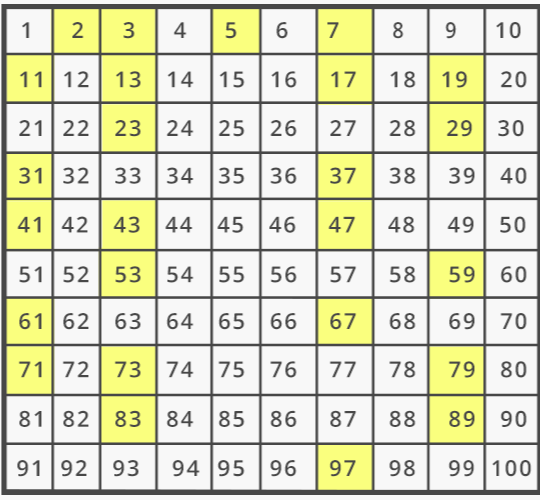
These numbers whose only factors are 1 and the number itself are called prime numbers.
Numbers having more than two factors are called composite numbers.
The number 1 has only one factor (i.e. itself) so, 1 is neither prime nor composite.
CO-PRIMES :
The numbers which have only 1 as the common factor are called co-primes or relatively prime.
e.g. (3, 5),(4,5)
TWIN PRIMES:
Twin primes are prime numbers that differ from each other by two.
e.g. (3, 5), (5, 7),(11, 13), (41, 43) etc.
PRIME FACTORIZATION:
When a number is expressed as a product of its factors, we say that the number has been factorized.
The process of finding the factors is called factorization.
METHODS OF PRIME FACTORIZATION:
1. Division Method : Prime factorisation of 42 using division method we proceed as follow:
Start dividing by the least prime factor. Continue division till the resulting number to be divided is 1.
Prime factorisation of 42 is 2 × 3 × 7
2. Factor Tree Method : We can find the prime factorization of 60 by drawing a factor tree.
To find the prime factorization of 60 using factor tree method, we proceed as follow:
Step-1:Express 60 as a product of two numbers.
Step-2:Factorise 4 and 15 further, since they are composite numbers.
Step-3:Continue till all the factors are prime numbers.