The free movement of a body with respect to time is known as motion. For example-the fan, the dust falling from the carpet, the water that flows from the tap, a ball rolling around, a moving car etc. Even the universe is in continual motion. Are all these motions the same? Is the motion of a pendulum the same as that of a moving car or train? There are various types of motions that are happening around us and they can be basically distinguished on the basis of:


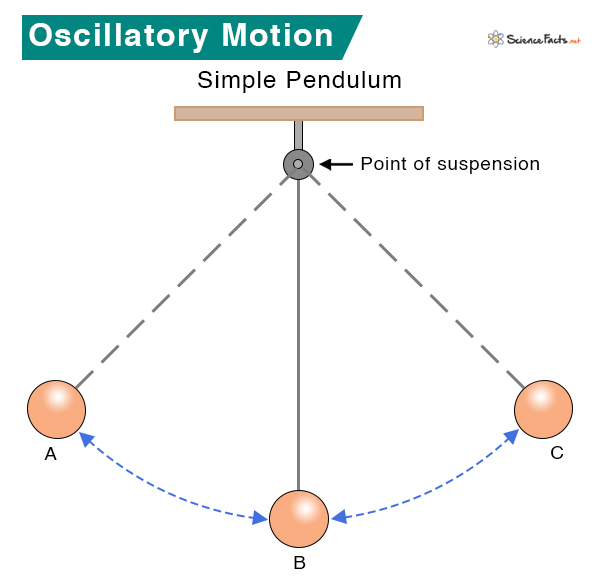

Oscillatory motion is defined as the to and fro motion of the body about its fixed position. Oscillatory motion is a type of periodic motion. Examples of oscillatory motion are vibrating strings, swinging of the swing etc:
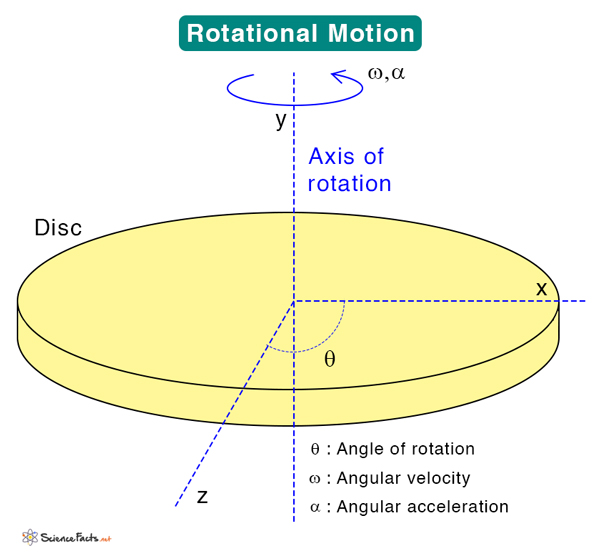
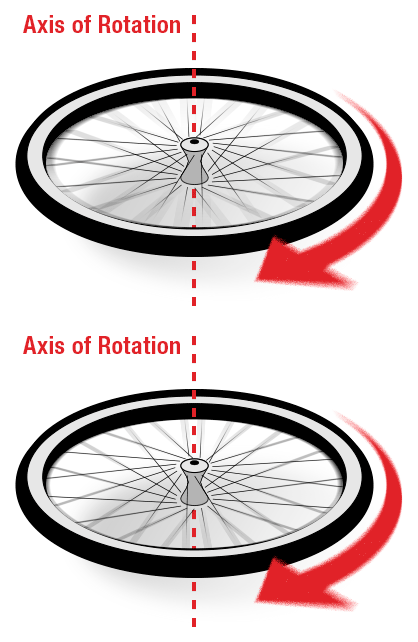
Purely rotational motion occurs if every particle in the body moves in a circle about a single line. This line is called the axis of rotation. Then the radius vectors from the axis to all particles undergo the same angular displacement at the same time. The axis of rotation need not go through the body.:
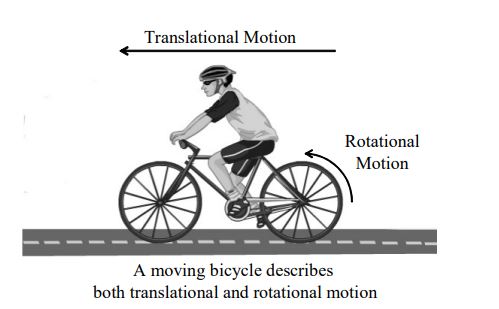

Motion in which all points of a moving body move uniformly in the same direction. If an object is undergoing translatory motion, we can note that there is no change in the object's orientation. Translatory motion is also known as translational motion:
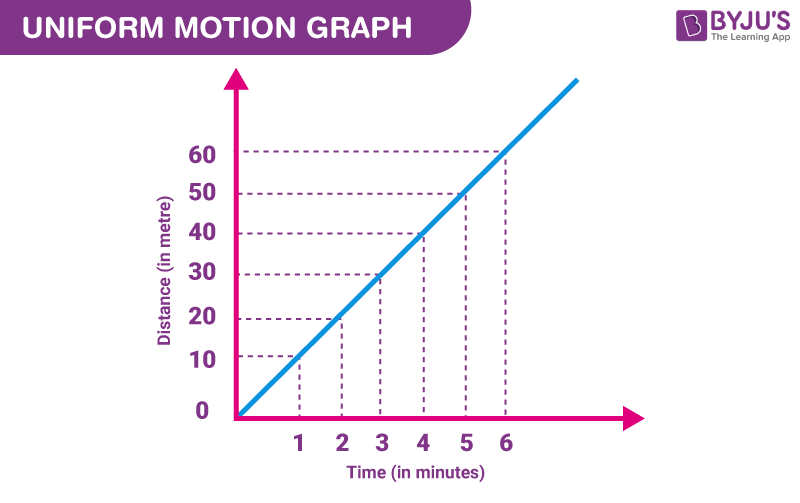

Definition: This type of motion is defined as the motion of an object in which the object travels in a straight line, and its velocity remains constant along that line as it covers equal distances in equal intervals of time, irrespective of the duration of the time:
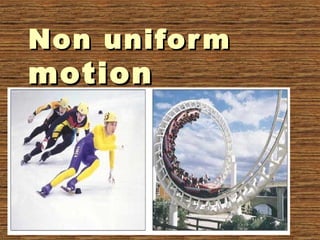
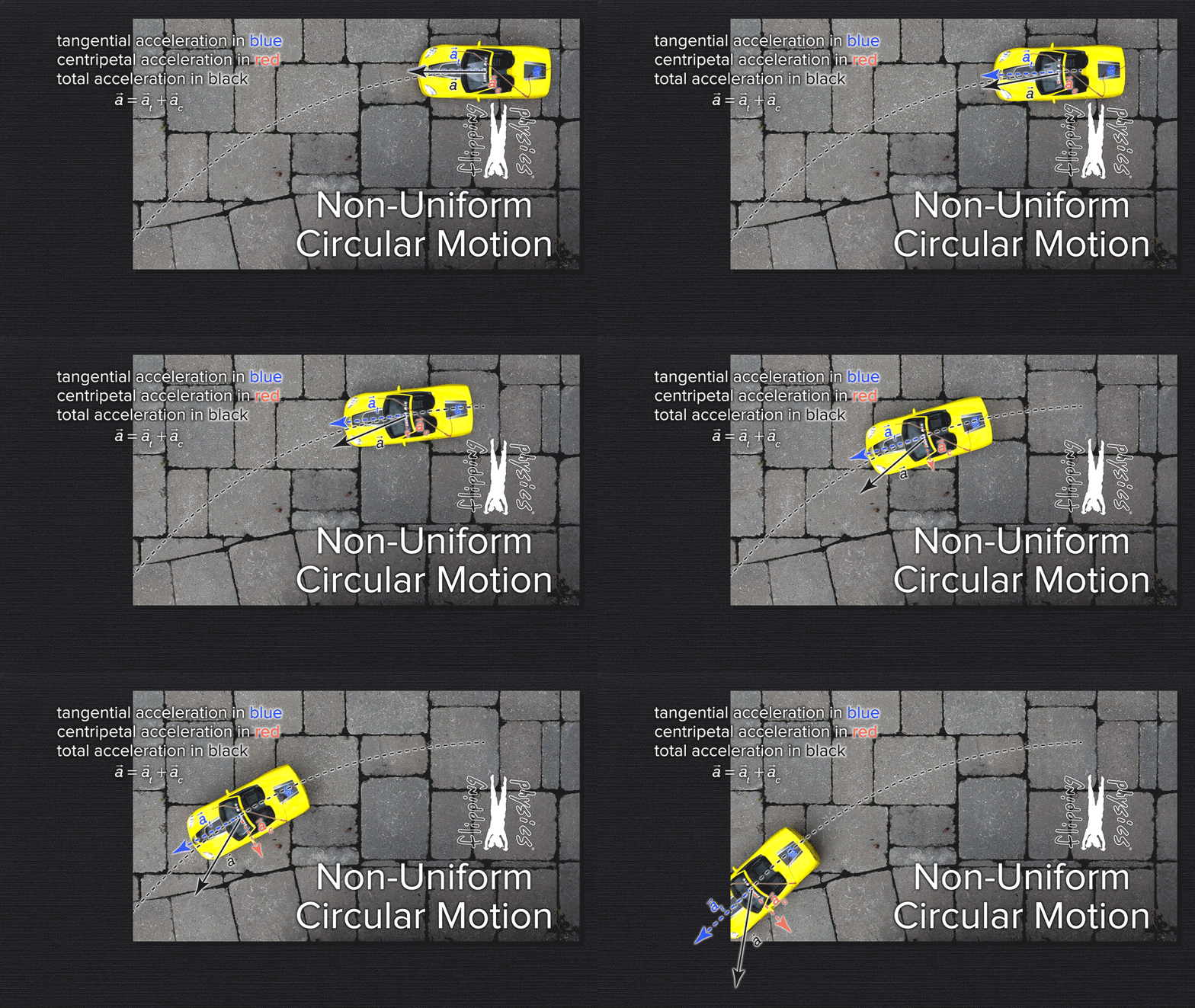
The type of motion in which the object travels with a varied speed is called Non-Uniform Motion. This means that the object does not cover equal distances in equal time intervals. If the motion is not consistent in the case of rectilinear motion, the acceleration of the body will be non-zero:
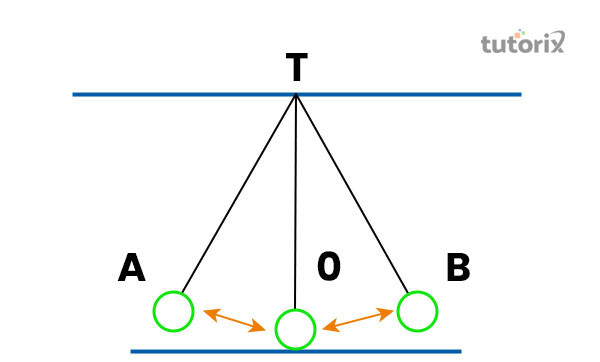

periodic motion, in physics, motion repeated in equal intervals of time. Periodic motion is performed, for example, by a rocking chair, a bouncing ball, a vibrating tuning fork, a swing in motion, the Earth in its orbit around the Sun, and a water wave.:


In physics, circular motion is a movement of an object along the circumference of a circle or rotation along a circular path. It can be uniform, with a constant angular rate of rotation and constant speed, or non-uniform with a changing rate of rotation:


Linear motion is the most basic of all motion. According to Newton's first law of motion, objects that do not experience any net force will continue to move in a straight line with a constant velocity until they are subjected to a net force: