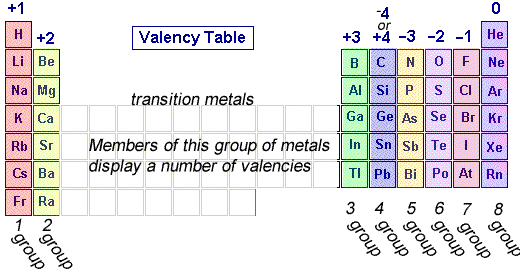
VALENCY
Valence, also spelled valency, in chemistry, the property of an element that determines the number of other atoms with which an atom of the element can combine. Introduced in 1868, the term is used to express both the power of combination of an element in general and the numerical value of the power of combination.
Variation Of Oxidation State Along a Period:
- While moving left to right across a period, the number of valence electrons of elements increases and varies between 1 to 8. But the valency of elements, when combined with H or O first, increases from 1 to 4 and then it reduces to zero. Consider two compounds containing oxygen Na2O and F2O. In F2O, the electronegativity of F is more than oxygen. Hence, each of F atom will attract one electron from oxygen i.e. F will show -1 oxidation state and O will show +2 oxidation state. Whereas, in the case of Na2O, oxygen is highly electronegative than sodium atom. So oxygen will attract one electrons from each sodium atom showing -2 oxidation state and Na will have +1 oxidation state. The oxidation state of the element represents the charge possessed by an atom due to the loss or gain of electrons (due to the electronegativity difference between the combining atoms) in the molecule.
Variation Of Oxidation State within a Group:
- As we move down in a group the number of valence electrons does not change. Hence, all the elements of a particular group group have the same valency.
Guidelines for assigning the Oxidation States
- Oxidation states of elements like O2, S8, H2, P4, Fe, etc are zero.
- Oxygen has an oxidation state of -2. But in its peroxides like Na2O2 and H2O2, it has -1 as its oxidation state
- Similarly, hydrogen has +1. But in Metal Hydrides, such as NaH, LiH, etc, it has -1
- Some elements have the same oxidation states as in their compounds such as
- Halogens have -1 except when they form a compound with one another or Oxygen.
- Alkali Metals such as Na, K, Rb, Li, Cs have +1
- Alkali Earth Metals have +2 such as Mg, Ca, Ba, Be, Sr, etc