UNIVERSAL LAW OF GRAVITATION
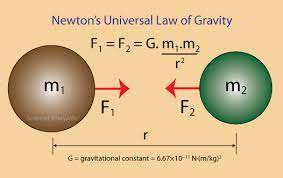
- Newton’s Law of Universal Gravitation states that every particle attracts every other particle in the universe with force directly proportional to the product of the masses and inversely proportional to the square of the distance between them.
The equation for universal gravitation thus takes the form:
F=G{\frac{m_1m_2}{r^2}}
- F = Force
- G = gravitational constant
- m_1= mass of object 1
- m_2= mass of object 2
- r= distance between centers of the masses
where F is the gravitational force acting between two objects, m1 and m2 are the masses of the
objects, r is the distance between the centers of their masses, and G is the gravitational
constant.
HISTORY
-
In 1604, Galileo Galilei correctly hypothesized that the distance of a falling object is proportional
to the square of the time elapsed.
- The relation of the distance of objects in free fall to the
square of the time taken was confirmed by Italian Jesuits Grimaldi and Riccioli between 1640
and 1650.
- They also made a calculation of the gravity of Earth by recording the oscillations of a
pendulum.
- A modern assessment about the early history of the inverse square law is that "by the late
1670s", the assumption of an "inverse proportion between gravity and the square of distance
was rather common and had been advanced by a number of different people for differentreasons".
- The same author credits Robert Hooke with a significant and seminal contribution,
but treats Hooke's claim of priority on the inverse square point as irrelevant, as several
individuals besides Newton and Hooke had suggested it.
- He points instead to the idea of
"compounding the celestial motions" and the conversion of Newton's thinking away from
"centrifugal" and towards "centripetal" force as Hooke's significant contributions.
- Newton gave credit in his Principia to two people: Bullialdus (who wrote without proof that there
was a force on the Earth towards the Sun), and Borelli (who wrote that all planets were attracted
towards the Sun).