
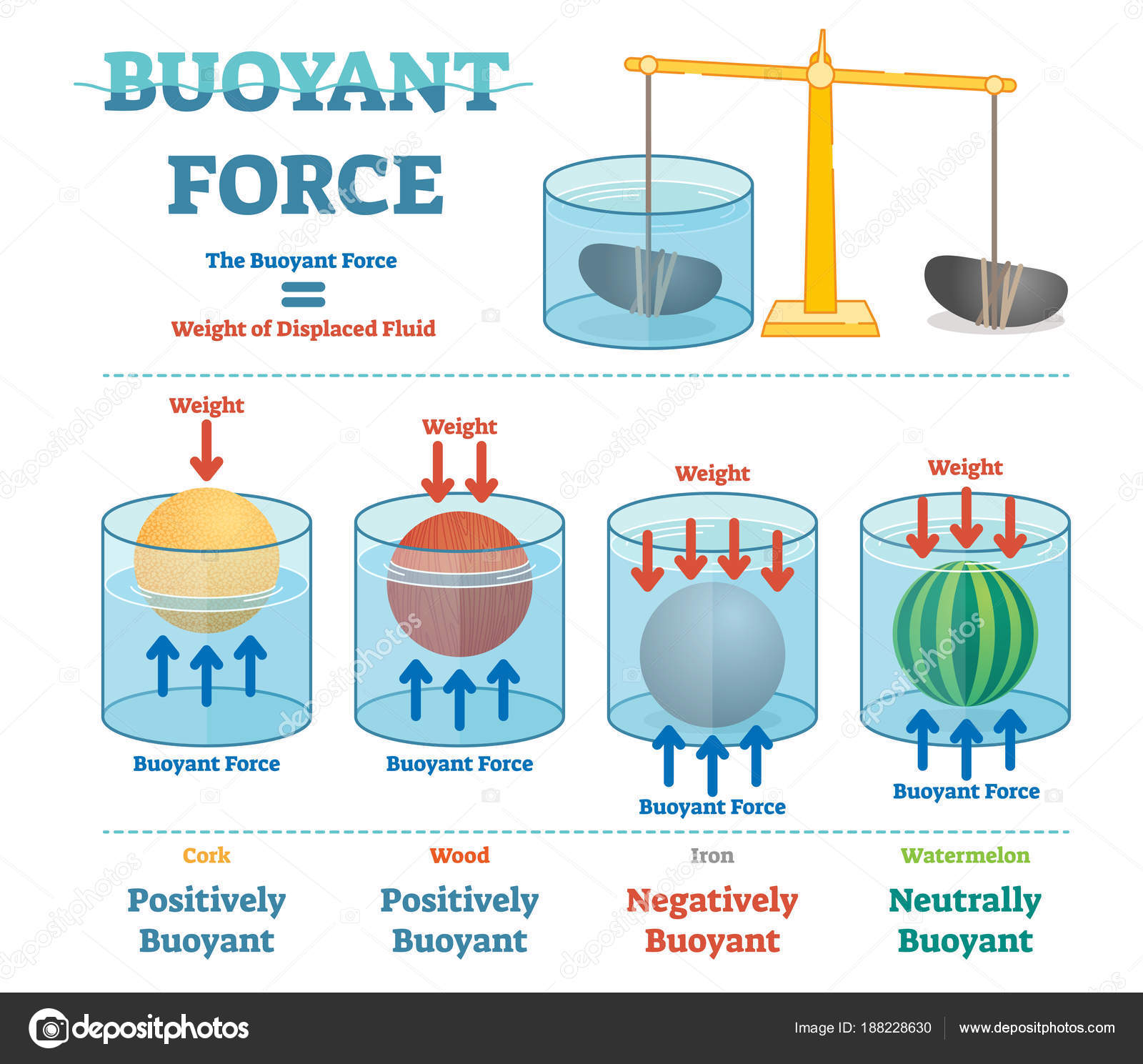
Buoyancy, discovered by the ancient Greek mathematician and inventor Archimedes. Buoyancy (the ability of an object to float in water or air) is intimately related to specific gravity. If a substance has specific gravity less than that of a fluid, it will float on that fluid: helium-filled balloons will rise in air For example:When an object is placed in liquid, it exerts an upward force on object. which makes the object appear to be lighter. This upward force is called buoyancy. The SI unit of buoyancy is Newton N.
Based on whether the object floats or sinks and if it floats or is fully immersed or partially immersed, buoyancy is classified. In a nutshell buoyancy and floatation define the type of buoyancy.
The three types of buoyancy are
∞ Positive buoyancy is when the immersed object is lighter than the fluid displaced, and this is the reason why the object floats.
∞ Negative buoyancy is when the immersed object is denser than the fluid displaced which results in the sinking of the object.
∞ Neutral buoyancy takes place when the weight of the immersed object is equal to the fluid displaced. The dive taken by the scuba diver is an ideal example of neutral buoyancy.
Applications of Buoyancy:
Buoyancy(upthrust) makes it possible for swimmers, fishes, ships, and icebergs to stay afloat. Some applications of buoyancy are given in the points below.
The atmosphere is filled with air that exerts buoyant force on any object. A hot air balloon rises and floats due to the buoyant force. It descends when the balloon’s weight is higher than the buoyant force. It becomes stationary when the weight equals the buoyant force.
A ship floats on the surface of the sea because the volume of water displaced by the ship is enough to have a weight equal to the weight of the ship. A ship is constructed in a way so that the shape is hollow to make the overall density of the ship lesser than the seawater. Therefore, the buoyant force acting on the ship is large enough to support its weight.
A certain group of fishes uses Archimedes’ principle to go up and down the water. To go up to the surface, the fish will fill its swim bladder (air sacs) with gases (clever, isn’t it?). The gases diffuse from their own body to the bladder and thus make the body lighter. This enables the fish to go up
The Bouyancy force doesnot change with depth.The difference between top force and bottom force is always the same no matter what the depth is.So fish have no problem reaching the bottom.They just die.